Don't Buy the Alliwava Gh8 Mini Pc Until You Read This Full Analysis
The Alliwava GH8 Mini PC has attracted attention as a compact, relatively affordable entry in the crowded mini desktop market. It promises desktop-like connectivity in a shoebox-sized chassis, targeting buyers who want a small office machine, a media center, or a secondary PC for light development tasks. Before anyone commits to a purchase, it helps to step back and look closely at real-world performance, expandability, thermals, connectivity, software support, and the kinds of use cases the GH8 is actually suited for. This full analysis walks through those areas and lays out who should seriously consider the GH8 — and who should look elsewhere.
Introduction: what the GH8 aims to be
Mini PCs such as the Alliwava GH8 aim to bridge the gap between ultra-portable devices and full-size desktops. They prioritize a small footprint, low power draw, and a wide set of external ports so a single device can handle office productivity, video playback, web conferencing, and light content creation. The GH8, in particular, has been marketed toward users who need more connectivity than a laptop offers, but don't want a bulky tower.
That promise is appealing, but practical buying decisions should be informed by how the device behaves under sustained loads, how easy it is to upgrade, and whether its ports and features match a buyer's needs. The rest of this article breaks those topics down into actionable guidance and details.
Detailed product review and analysis
Design, build quality, and footprint
The GH8 adheres to the standard mini PC form factor: a small rectangular chassis that can be tucked behind a monitor or placed on a desk with little visual impact. For buyers who prioritize space savings — for example, crowded home offices or living rooms — this is a clear advantage.
Material choices and finish vary between units and production runs. In general, the chassis is compact and functional rather than premium-feeling. For desktop replacement expectations, the build is adequate, but it is not competition for premium aluminum-cased mini-desktops. The placement of vents and ports matters because it directly affects cooling and cable management.
Performance and real-world behavior
Performance with the GH8 depends heavily on the specific internal configuration: CPU model, amount of RAM, and the storage solution (NVMe SSD vs SATA or eMMC). In real-world usage the GH8 performs well for common tasks such as web browsing with multiple tabs, office productivity, video streaming up to 4K (with hardware decoding), and basic photo editing. It is less well suited to sustained high-CPU workloads like large-scale compilation, long video exports, or heavy virtualization without selecting the higher-end configuration.
Important performance considerations observed in similar mini PCs that apply to the GH8 include:
- Short bursts vs sustained loads: Mini PCs often handle short bursts of CPU or GPU load well but can throttle under sustained heavy loads due to thermal limits.
- Integrated graphics for media: Integrated GPUs typically handle streaming and light media work fine, but do not replace a discrete GPU for gaming at higher settings.
- RAM and storage matter more than many buyers realize: Moving from 8GB to 16GB RAM and installing an NVMe SSD can dramatically improve perceived responsiveness for multitasking.
Thermals and cooling
Thermal design is a key differentiator in mini PCs. The GH8’s compact size constrains airflow and heatsink volume; as a consequence, under heavy sustained loads the unit can get warm and may reduce CPU frequency to manage temperature. For light office work and media playback, this is not usually noticeable. However, buyers planning to run long compile jobs, encode video, or use the device as a virtual machine host should be cautious and consider cooling behavior before buying.
Port selection and connectivity
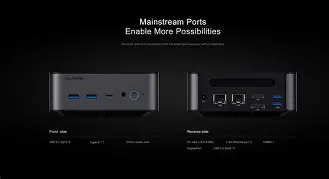
One of the main selling points for small desktops is their port density. The GH8 typically provides a mix of USB-A, USB-C (often with PD support in some SKUs), HDMI/DisplayPort outputs, Gigabit Ethernet, and audio jacks. This makes the device useful as a small-footprint workstation that can connect multiple displays, external drives, and wired networks simultaneously.
Find top-rated Laptops & Computers products at great prices.
Shop Amazon →Buyers should verify the exact port set of the specific GH8 configuration under consideration. For example, it is important to confirm whether USB-C supports DisplayPort Alt Mode and power delivery, and whether the HDMI port supports 4K at 60Hz or only 30Hz. These details affect multi-monitor setups, docking scenarios, and compatibility with peripherals.
Storage and upgradeability
Mini PCs trade internal expansion for compactness, and the GH8 is no exception. Common configurations may include soldered RAM or single SO-DIMM slots, a single M.2 socket for NVMe storage, and sometimes a 2.5" bay for a SATA drive. Upgrade paths vary by SKU and revision.
Key buyer takeaway: confirm whether RAM is upgradable and whether the unit has an M.2 slot that supports NVMe. For long-term use, prioritizing models with a user-accessible M.2 slot and at least one RAM slot is advisable.
Software, BIOS, and driver support
Software and driver support for mini PCs can be uneven. The GH8 may ship with Windows, a Linux-friendly BIOS, or without an OS. Experience with driver availability can vary; some components (Wi-Fi modules, audio codecs) may need vendor drivers to reach full functionality. Buyers planning to run Linux should check community resources and vendor documentation for compatibility notes.
Noise and power consumption
Mini PCs like the GH8 generally have low power draw at idle, making them suitable for always-on tasks like light servers, network-attached media playback, and background downloads. Fan noise is usually modest under light load but can rise noticeably under stress if the cooling system becomes active. For noise-sensitive environments (bedrooms, quiet studios), this is an important consideration.
Pros & Cons
- Pros:
- Small footprint suitable for tight spaces and discreet placement
- Good port selection for desktop-style connectivity (multiple USB, Ethernet, video outputs)
- Low idle power draw and adequate performance for productivity and media playback
- Often competitively priced compared with full-size desktops
- Suitable as a second machine, media center, or light office desktop
- Cons:
- Thermal limits can cause throttling under sustained heavy workloads
- Upgradeability depends on SKU — RAM may be soldered in some models
- Build quality and materials are functional but not premium in many units
- Driver and Linux support can be inconsistent depending on internal components
- Not a replacement for a desktop with a discrete GPU or high-core-count CPU for demanding tasks
Comparison table: Alliwava GH8 vs typical mini PC alternatives
| Feature | Alliwava GH8 | Typical Intel NUC (comparable class) | Typical Minisforum / Beelink-style mini PC |
|---|---|---|---|
| Performance range | Entry to mid-range depending on configuration | Wide range; easy to find higher-end SKUs | Similar to GH8; often broad SKU selection |
| Port selection | Good balance of USB, video, Ethernet (varies by model) | Typically strong, often with Thunderbolt/USB-C options | Generally comparable; sometimes fewer high-speed ports |
| Upgradeability | Variable — M.2 often, RAM may be soldered in some SKUs | Often designed for user upgrades (RAM, SSD) | Variable; many offer at least M.2 slot |
| Thermals | Adequate for light use; can throttle under sustained loads | Often better optimized with sophisticated cooling in premium SKUs | Similar challenges; depends on chassis and CPU |
| Price-to-value | Competitive for entry/mid-range buyers | Can be higher for brand premium | Often competitive with GH8 |
| Software support | Mixed — check drivers and Linux compatibility | Strong vendor support for drivers | Mixed; depends on brand and components |
Real-world use cases
It helps to evaluate the GH8 against specific buyer scenarios. The following examples illustrate where the GH8 tends to excel and where limitations appear.
Home office / remote work
For users who need a reliable desktop for video calls, spreadsheets, document work, and cloud-based tools, the GH8 is often a good fit. Its compact size and port selection allow dual-monitor setups and wired Ethernet for stable conferencing. Buyers should choose a configuration with at least 8–16GB of RAM and an SSD for best responsiveness.
Media center / living room PC
The GH8 can serve well as a living-room streaming device or HTPC, particularly if it supports hardware decoding for modern codecs and has the appropriate HDMI output for 4K@60Hz. Low idle power draw and quiet operation during playback make it attractive for this role.
Find top-rated Laptops & Computers products at great prices.
Browse Now →Light content creation and photo editing
For amateur photo editing and short video edits, a GH8 model equipped with a more capable processor and 16GB of RAM can manage workflows. However, prolonged exports and GPU-heavy tasks will be faster on machines with discrete GPUs.
Software development and testing
The GH8 is suitable for general development work such as web development, scripting, and small containerized services. For projects requiring many parallel containers, virtual machines, or heavy compilation, buyers should opt for configurations with higher core counts and better cooling — or consider a more powerful desktop.
Light gaming
Integrated graphics limit gaming to lower settings for recent titles. Older or less demanding games run fine. If gaming is a priority, a laptop or desktop with a discrete GPU is preferable.
Buying guide: what to check before purchasing
Before purchasing an Alliwava GH8, verify the following items to ensure the unit meets specific needs:
- Exact CPU and performance tier: Look up the exact processor model on the specification page and compare its benchmarks to the intended workload. Avoid assumptions based on model name alone.
- RAM configuration and upgradeability: Confirm whether RAM is soldered or uses SO-DIMM slots. If the unit has soldered RAM, buy a configuration with sufficient memory for future needs.
- Storage options: Ensure an NVMe M.2 slot is available if fast storage is important, and check for an additional 2.5" bay if large capacity HDD/SSD plans exist.
- Video output capabilities: Verify HDMI/DisplayPort versions and whether the unit supports 4K@60Hz when that is required for monitors or TVs.
- USB-C features: If USB-C is part of the workflow (docking, charging, or video), confirm PD and DP Alt Mode support.
- Networking: For stable remote work, prefer Gigabit Ethernet and confirm whether Wi-Fi and Bluetooth modules are from reputable vendors (Intel, Broadcom).
- Cooling behavior under load: Read user reviews and tests for thermal throttle behavior. If possible, find benchmarks representing sustained workloads.
- Driver and OS compatibility: If planning to run Linux, search for compatibility notes or community reports for the GH8 configuration of interest.
- Warranty and support: Check the warranty period and the vendor’s policy for returns or repairs. Mini PC vendors vary widely in support responsiveness.
- Port layout and cable management: Look at photos of the actual unit to confirm the port layout will work with the intended desk arrangement.
Questions to ask sellers and listings
- Does the GH8 come with a pre-installed operating system or as a barebones unit?
- Is the RAM single module or dual-channel? If single, is there an empty slot for expansion?
- What is the exact Wi-Fi/Bluetooth chipset model?
- Does the unit include VESA mounting hardware if the plan is to mount it behind a monitor?
- Can the vendor provide thermal logs or benchmark results for sustained workloads?
Alternatives worth considering
If the GH8’s constraints raise concerns, consider these alternative approaches:
- Select a mini PC model with proven thermal management and stronger vendor support if sustained workloads are common.
- For media-first setups, consider a dedicated streaming device or a device explicitly designed for HTPC use with verified 4K@60Hz output and low-noise operation.
- For gaming or heavy GPU tasks, a small form-factor desktop with a discrete GPU or a gaming laptop will provide the required performance.
Conclusion
The Alliwava GH8 Mini PC can be a compelling choice for buyers who need a compact, affordable machine for everyday productivity, media playback, and light content creation. Its strengths are its small footprint, reasonable port selection, and suitability as a second machine or home office desktop. However, the GH8 is not a one-size-fits-all solution. Thermal limitations, potential constraints around RAM and storage upgradeability, and variability in driver support mean buyers must scrutinize the specific configuration carefully and match it to their intended workloads.
In short: do not buy the GH8 on brand recognition alone. Confirm the exact CPU, RAM and storage options, check thermal behavior for the workload expected, verify port capabilities (especially for video and USB-C), and ensure driver or OS support aligns with the buyer’s preference. For many users, especially those with basic office and media needs, the GH8 is a practical, space-saving option. For power users and those with sustained heavy workloads or gaming needs, a different platform may deliver better long-term value.